
NOT JUST CANNONS, 250 YEARS OF INNOVATION IN ARTILLERY MATERIALS
From 22/04/2014 to 13/07/2014. Every day
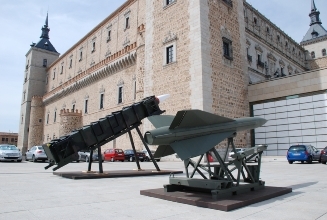
Commissioner: Francisco Rodríguez Padrón, retired Artillery Colonel.
Since armies made their appearance in the Ancient Age, they have evolved to adapt to the changes that were emerging in the fields of tactics, technology, weaponry, etc. In this sense, in the Middle Ages the shooting weapons that were used in the attack and defense of fortifications were the so-called neuroballistics, that is, those whose devices took advantage of the energy accumulated by the twisting, tension and bending of both vegetable and animal fibers to throw large stones, spears, arrows, etc. Its decline began with the appearance of gunpowder and therefore that of pyroballistic weapons, which used the energy produced by the deflagration of this compound to throw stone bolaños and other objects. In the case of the Iberian Peninsula, the first documented data on the use of this type of artillery indicate that it was in 1331 during the sieges of Alicante and Orihuela. From then on, this primitive artillery would initially be manufactured and handled by artisans and specialized soldiers.
The accession to the throne in 1759 of Charles III provided providential faith for the Artillery, since until then its organization left much to be desired. A faithful follower of the ideas advocated by the Enlightenment and helped by the Count of Gazola, his closest collaborator, he created the Royal Artillery Corps in 1762 and established his Royal College in the Alcázar of Segovia.
THE MAIN OBJECTIVE OF THE EXHIBITION is to show the advances introduced in artillery materials by the students of the Royal College of Artillery and the Artillery Academy, its heir since 1867.
To this end, the aim is to make the general public aware of the different facets of the training of artillery officers that have enabled them, for example, to improve materials, ammunition and auxiliary elements and to introduce new procedures for the use of material, means of calculating trajectories and determining meteorological corrections at any given time.
The exhibition will basically focus on the evolution of the muzzle corresponding to classic artillery (generically known as "cannon artillery", which together with rocket artillery form the two large groups into which artillery is divided), its accessories and ammunition, as well as other elements directly related to it: aiming elements and how to execute them, elements for measuring distances, calculating shooting data and determining weather conditions.