

- Home
- UNITS
- Madrid
- Texto no traducido
- News about the Unit
- Texto no traducido
- Logística Farmacéutica Militar en las III jornadas de Sanidad Militar Operativa

MENÚ UNIDAD
ARMY UNITS
- Araba Álava |
- Albacete |
- Alicante |
- Almería |
- Asturias |
- Ávila |
- Badajoz |
- Barcelona |
- Burgos |
- Cáceres |
- Cádiz |
- Cantabria |
- Castellón |
- Ceuta |
- Ciudad Real |
- Córdoba |
- A Coruña |
- Cuenca |
- Girona |
- Granada |
- Guadalajara |
- Gipuzkoa |
- Huelva |
- Huesca |
- Islas Baleares |
- Jaén |
- León |
- Lleida |
- Lugo |
- Madrid |
- Málaga |
- Melilla |
- Murcia |
- Navarra |
- Ourense |
- Palencia |
- Las Palmas |
- Pontevedra |
- La Rioja |
- Salamanca |
- Segovia |
- Sevilla |
- Soria |
- Tarragona |
- Santa Cruz de Tenerife |
- Teruel |
- Toledo |
- Valencia |
- Valladolid |
- Bizkaia |
- Zamora |
- Zaragoza
News
Thursday, October 29, 2026
Number: 46
Military Pharmaceutical Logistics at the 3rd Operational Military Health Conference
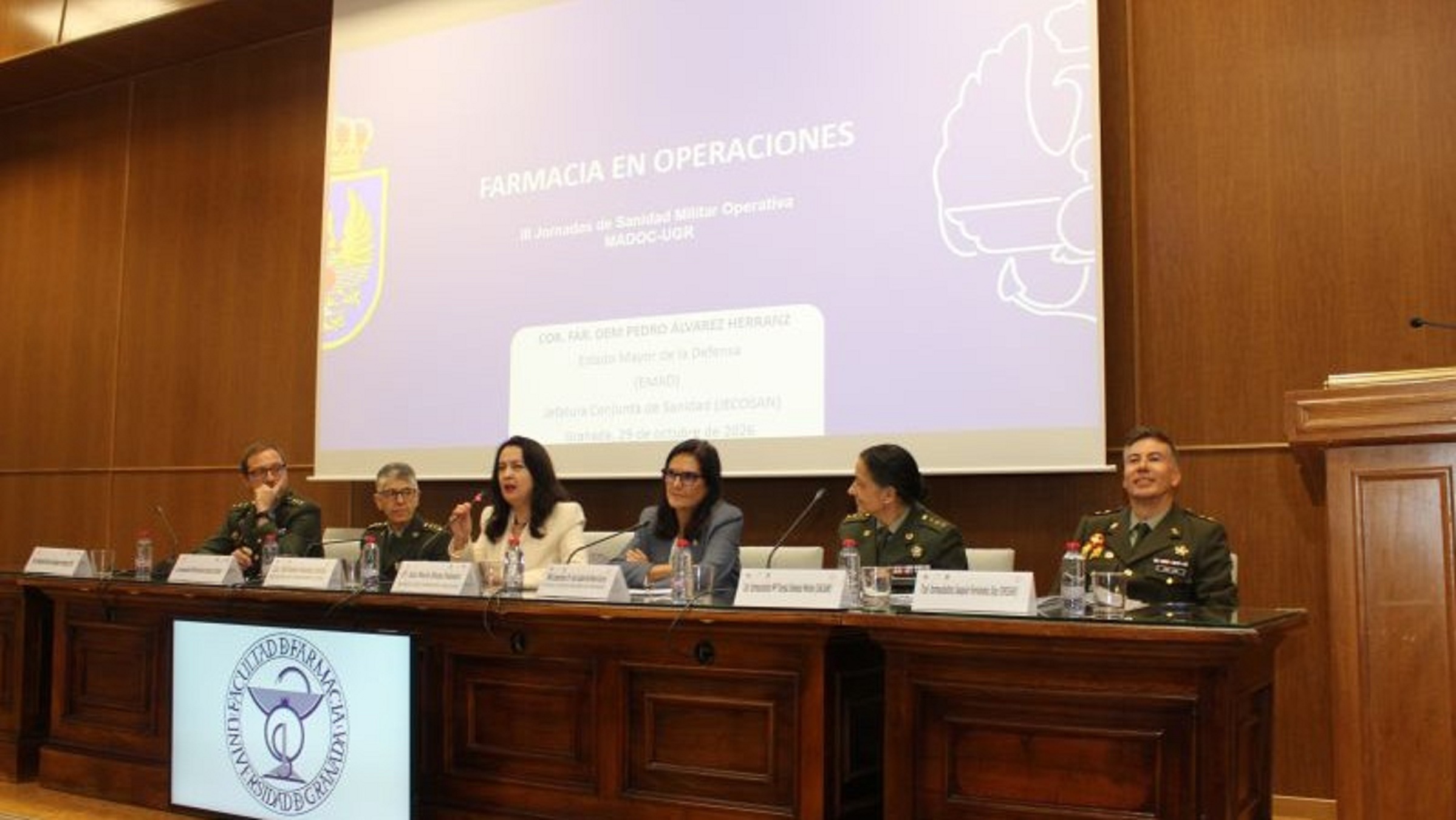
Speakers
On October 29th, the University of Granada and MADOC organized the 3rd Operational Military Health Conference under the title “MILITARY HEALTH: A PROFESSIONAL CAREER BEYOND THE CONVENTIONAL HEALTHCARE ENVIRONMENT.”
With the aim of increasing awareness of the Military Health Corps as a unique professional model within the healthcare system—combining the practice of healthcare professions with emergency response capabilities, operational support, international cooperation, healthcare research, and innovation—the event highlighted those specialties in which the Army has officers deployed in overseas operations. The conference took place across four campuses of the University of Granada (Cartuja, PTS, Ceuta, and Melilla) in front of students from the faculties of Health Sciences.
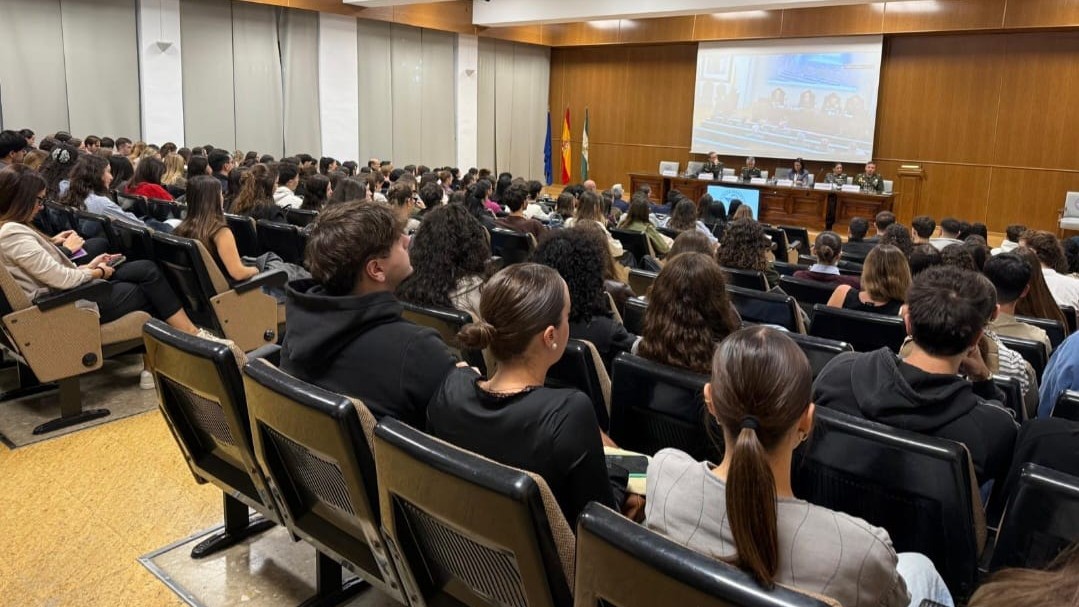
Attendees of the Presentation
At the Faculty of Pharmacy, in a grand auditorium filled with students and in the presence of top academic officials (the Dean and Vice-Dean) as well as the Deputy Director General of Pharmaceutical Support and Regulation, the presentation addressed the two fundamental pillars of the core Pharmacy specialty: health resource management and analytical capacity.
Within this framework, the Colonel Chief of the Healthcare Logistics Support Unit (UALSAN) participated with a presentation titled “Military Pharmaceutical Logistics.” This presentation provided a broad overview of the pharmaceutical logistics structure based in the National Territory that sustains healthcare in international missions to guarantee the operational readiness of deployed Units and the fulfillment of their mission.
Starting with the concept of logistics centered within a hostile framework of action (armed conflicts, emergencies, disasters, etc.) and backed by the historical importance of the industrial production of penicillin and its mass distribution to the battlefield—which was decisive for the Allied victory in World War II—while also developing upon the regulations stemming from Royal Decree 1155/2020, she addressed the logistics chain of health resources as the central part of her intervention.
She highlighted the fundamental role of two key links: the Defense Military Pharmacy Center, the only publicly owned pharmaceutical laboratory, as an essential tool for national security and defense from a healthcare perspective due to its ability to manufacture medicines of national strategic interest and specific medications for the Armed Forces; and the Wholesale Pharmaceutical Warehouses (AFM), which, through the application of good distribution practices and the principle of opportunity, deliver the required resource (under conditions of safety, quality, and efficacy) at the right time and place.
She explained how, within the scope of the Army, UALSAN—integrated and leveraging synergies—is responsible for the supply and maintenance of all resources required in international misiones by all fundamental specialties of the Military Health Corps: medicine, pharmacy, veterinary medicine, dentistry, psychology, and nursing. This is because UALSAN operates as an AFM while simultaneously acting as the Central Logistics Organ (OLC) of the Logistics Centers Headquarters, living up to its motto:
United, to serve ¡¡¡¡¡¡¡¡¡¡¡

Información
Mapa del sitio