

- Home
- 'Boletín Tierra' Newspaper Reports
- Full article
THE “LA ERA” TAPESTRY RETURNS TO BUENAVISTA PALACE FOLLOWING ITS RESTORATION.
Tuesday, April 6, 2010
Number: 680
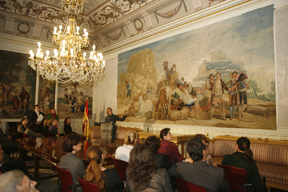
The La Era tapestry, full of colour, has returned to occupy the central wall of the Goya hall at Buenavista Palace, Army Headquarters, after the conclusion of the restoration process which it has undergone for its cleaning and conservation.
Its return to the Palace was commemorated in a ceremony on 6th April, presided over by the Chief of the Army Staff, Army General Coll, accompanied by the president of National Heritage, Mr. Yago Pico de Coaña.
Besides having recuperated the brightness of the colours of the hundreds of threads comprising it and restoring the damage caused by the passage of time and pollution, it has been placed by means of an adhesion system that is less aggressive and totally innocuous for the cloth material: Velcro tape. Previously, it was habitual for them to be fixed to the wall and framed with mouldings, which ended up causing tears and distortions in the fabric.
Goya’s Tapestry Cartoons
The restored piece comprises part of The Four Seasons series, created from Francisco de Goya’s cartoons. To be precise, the image that it represents –a group of peasants working during that period- evokes summer, which is the time for reaping fields.
Along with this image, to the side, another work is found, representing autumn. Known as The Grape Harvest, it is the other tapestry of the series that covers the walls of the hall dedicated to the brilliant Aragonese painter.
These tapestries were created at the Royal Factory of Saint Barbara to adorn the King’s dining room at the Pardo Palace, at the end of the 18th century. They belong to the Royal Collection, 40 of whose specimens are on exhibit in various rooms of the palace, lent on deposit by National Heritage since 1939, along with some other works of great value such as paintings or a collection of clocks.
The Army, interested in the maintenance of its cultural heritage, began a restoration programme for these tapestries in 2006. In his address, the president of National Heritage highlighted the “exemplary collaboration” that exists between both institutions to guarantee the conservation of these works and their public exhibition; as well he assured the Chief of the Army Staff of his firm intention that Army Headquarters should continue to be to the custodian of the tapestry indefinitely.
ARMY UNITS
- Araba Álava |
- Albacete |
- Alicante |
- Almería |
- Asturias |
- Ávila |
- Badajoz |
- Barcelona |
- Burgos |
- Cáceres |
- Cádiz |
- Cantabria |
- Castellón |
- Ceuta |
- Ciudad Real |
- Córdoba |
- A Coruña |
- Cuenca |
- Girona |
- Granada |
- Guadalajara |
- Gipuzkoa |
- Huelva |
- Huesca |
- Islas Baleares |
- Jaén |
- León |
- Lleida |
- Lugo |
- Madrid |
- Málaga |
- Melilla |
- Murcia |
- Navarra |
- Ourense |
- Palencia |
- Las Palmas |
- Pontevedra |
- La Rioja |
- Salamanca |
- Segovia |
- Sevilla |
- Soria |
- Tarragona |
- Santa Cruz de Tenerife |
- Teruel |
- Toledo |
- Valencia |
- Valladolid |
- Bizkaia |
- Zamora |
- Zaragoza
OUTSTANDING LINKS

Mapa del sitio