

- Home
- 'Boletín Tierra' Newspaper Reports
- Full article
THE MENORCA CONSORTIUM, AN EXAMPLE OF A SOLUTION TO THE PROBLEMS OF MILITARY INSTALLATIONS IN DISUSE.
Monday, December 14, 2009
Number: 659
Without loss of building ownership, their maintenance does not entail expenses for the Army
Redacción/Madrid
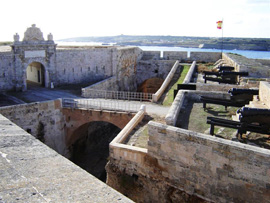
The solution taken in Menorca to maintain ownership of the military installations without incurring expenses for the institution by means of the creation of a Consortium has demonstrated its viability after more than a decade of existence, thus serving as an example for other garrisons in similar situations.
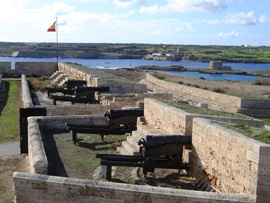
At present the island has a small garrison with some thirty officers, non-commissioned officers and troop, some of whom are in the reserve, who maintain a base, a firing range, a logistic residence, a military club, and manage a Consortium that includes the “La Mola” Fortress, “San Felipe” Castle, “d'en Penjat” Tower, “San Felipet Fortress” and the Military Museum, visited annually by over 50,000 visitors.
This popular success makes evident the wise decision by a group of service people who, faced with the problems of what to do with military installations in disuse, mobilised in search of a solution that would allow for, on the one hand, maintaining ownership of something that had always been in the hands of the Army, which in case of need, is able to return to its use for National Defence, while on the other, would not generate expenses.
In this manner, in the summer of 1998, a Consortium was founded with the participation of the Ministry of Defence, the Balearic Government, the Insular Council of Menorca and the Municipal Governments of Mahón and Es Castell. The Ministry of Defence placed at its disposal the installations of cultural interest for a period of fifty years, so that their exploitation would allow for their conservation and contribute to increasing the island’s cultural offer as well as the dissemination of military culture.
This management has demonstrated its capability to be economically independent, by generating income that permits the conservation, improvement and market valuation of the assets, which is evident to anyone who visits these installations.
A Problem Stemming from the Reduction of Garrisons
In recent times the Balearic Islands garrison, like others in the rest of Spain, have seen themselves noticeably reduced. Concepts such as projection and professionalization have been imposed over others like territoriality and obligatory military service; as well the latter were what made possible the presence of numerous units with adequate coverage at a large number of points in Spain.
With the units dissolved the military installations that had accommodated them remained on the land, some without any value, others with strategic value and still others of great cultural value. The question to resolve was what to do with them, whether to abandon and transfer them, or conserve them with the resulting cost.
Protection of Historic Buildings
Menorca has been a site whose strategic location on the Mediterranean Sea had made it a crossroads for various cultures and an object of desire of the dominant empires at each moment; throughout the centuries this gave rise to the appearance of fortifications of various types designed by the best engineers of the times that have reached our days in a good state of conservation, which has allowed them to be catalogued as property of cultural interest.
At the end of the 20th century it had a garrison of nearly 2,000 men with Infantry, Coast Artillery, Anti-aircraft Artillery, Field Artillery, Engineer, Logistic, and Military Hospital units, all at the command of a general. Most of the units were found garrisoned at “Isabel II” Fortress , “San Felipe” Castle and “Es Castell” Barracks, constructed by the English in the 18th century and of great cultural value, as the Military Governor has his headquarters in a 16th century Palace in the city centre of Mahón. The remaining units were already accommodated in a modern, model barracks on Base "San Isidro", with a 502 hectare training camp.
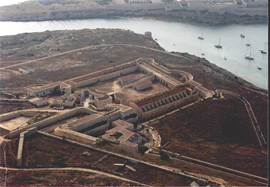
On the most modern installation, a Projection Support Unit was constructed which would permit the barracks and the training camp to be maintained and used temporally for instruction and training by various Spanish Army and NATO units.
The other three went on to make up part of the Menorca Military Museum Consortium and Mahón Port Historical Patrimony, which already have other equivalents –although of a smaller entity- such as “San Fernando” Castle in Figueras and the Citadel in Jaca, an indisputable sign of having been converted into a reference to be taken into account at other points of the Spanish geography where the same type problems are present.
All information regarding the Consortium may be consulted on the Internet at the Web site
ARMY UNITS
- Araba Álava |
- Albacete |
- Alicante |
- Almería |
- Asturias |
- Ávila |
- Badajoz |
- Barcelona |
- Burgos |
- Cáceres |
- Cádiz |
- Cantabria |
- Castellón |
- Ceuta |
- Ciudad Real |
- Córdoba |
- A Coruña |
- Cuenca |
- Girona |
- Granada |
- Guadalajara |
- Gipuzkoa |
- Huelva |
- Huesca |
- Islas Baleares |
- Jaén |
- León |
- Lleida |
- Lugo |
- Madrid |
- Málaga |
- Melilla |
- Murcia |
- Navarra |
- Ourense |
- Palencia |
- Las Palmas |
- Pontevedra |
- La Rioja |
- Salamanca |
- Segovia |
- Sevilla |
- Soria |
- Tarragona |
- Santa Cruz de Tenerife |
- Teruel |
- Toledo |
- Valencia |
- Valladolid |
- Bizkaia |
- Zamora |
- Zaragoza
OUTSTANDING LINKS

Mapa del sitio