

- Home
- 'Boletín Tierra' Newspaper Reports
- Full article
MILITARY MUSIC AND HISTORY TO CELEBRATE THE “WHITE NIGHTS FESTIVAL” AT ARMY HEADQUARTERS.
Wednesday, September 23, 2009
Number: 631
Beatriz Gonzalo/Madrid
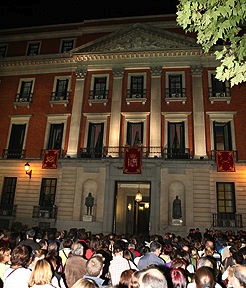
The call of trumpets that served as an introduction to the “Heraldic Fanfare” filled Madrid’s “White Nights Festival” with warlike sounds on 19th September, in order to receive the general public visiting “Buenavista” Palace, Army Headquarters on such a special night.
For the occasion, the palace had illuminated its facade as it opened and decorated its balconies with the national coat of arms, as well as the shields of the coats of arms of Artillery, Infantry, Cavalry and Engineers.
The same resource employed by Verdi in the opera "Aida" to advise the public that something important was about to occur on stage served to call the visitors’ attention, as they gathered by the dozens before the facade of the imposing building, and to begin the programme of activities.
On the central balcony appeared the figures of the two palace guides flanked by a pair of military musicians. The latter played their 14th and 15th Century straight trumpets with their characteristic sound, while through the main arch the King’s Immemorial 1st Infantry Regiment Military Band made its entrance while performing in response another fanfare, which is employed as the entry call for the changing of the palace guards.
A historical review brightened up with music
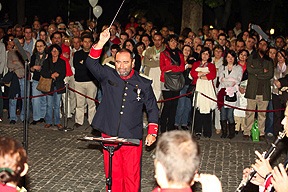
In this manner began the first narration of the history of “Buenavista” Hillock, from its past as property of the cardenal archbishop of Toledo, Mr.Gaspar de Quiroga, to its role as royal quarter, palace of the House of Alba, Artillery museum and the Ministry of War.
During the historical review mention was also made of illustrious inhabitants such as General Prim, who after underging an assassination attempt while returning from the House of Commons, ended up dying in his office due to wounds which at present wouldn’t have had been serious but in the 19th Century caused death due to septicaemia.
The talk was livened up by some of the most representative military marches, such as the “Golden Orgy” (better known as “Little Spanish Soldier”) or “The Corsairs” (popularly nicknamed “The Little Flag”).
Three sessions were offered in the same structure, from 9:00 pm until 10:30 pm, but the fourth scheduled was replaced by a performance by the Military Band, so making it the protagonist of the night and closing the activities with the performance, by public acclamation, of the Infantry hymn and typical popular music from Madrid.
ARMY UNITS
- Araba Álava |
- Albacete |
- Alicante |
- Almería |
- Asturias |
- Ávila |
- Badajoz |
- Barcelona |
- Burgos |
- Cáceres |
- Cádiz |
- Cantabria |
- Castellón |
- Ceuta |
- Ciudad Real |
- Córdoba |
- A Coruña |
- Cuenca |
- Girona |
- Granada |
- Guadalajara |
- Gipuzkoa |
- Huelva |
- Huesca |
- Islas Baleares |
- Jaén |
- León |
- Lleida |
- Lugo |
- Madrid |
- Málaga |
- Melilla |
- Murcia |
- Navarra |
- Ourense |
- Palencia |
- Las Palmas |
- Pontevedra |
- La Rioja |
- Salamanca |
- Segovia |
- Sevilla |
- Soria |
- Tarragona |
- Santa Cruz de Tenerife |
- Teruel |
- Toledo |
- Valencia |
- Valladolid |
- Bizkaia |
- Zamora |
- Zaragoza
OUTSTANDING LINKS

Mapa del sitio