- Home
- 'Boletín Tierra' Newspaper Reports
- Full article
OPERATIONAL ACTIVITIES CONCLUDE FOLLOWING A TEN-YEAR MISSION IN KOSOVO.
Monday, August 17, 2009
Number: 620
Beatriz Gonzalo / Madrid
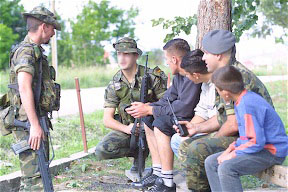
The three patrols returning to Base "España" on 31st July last were the final ones to travel over the area of Spanish action in Kosovo, thus drawing to a close the operational activities that had begun ten years earlier.
The Spanish Force in Kosovo Task Force KSPFOR XXIII "Castilla y León", under the command of Colonel García Blázquez and principally integrated by units from the Field Artillery Command has brought the mission in this area of operations to a close. It is the end of a road that was initiated on 22nd June 1999. It was on that date when 1,200 service persons from the 2nd Legion Light Infantry Brigade "Rey Alfonso XIII", commanded by Colonel Díaz de Villegas, transferred to the Balkans to be included in a Multinational Brigade detached in Pec and led by the Italian Army.
That was the first step after United Nations Security Council authorisation of deployment of a multinational force —the International Force for Kosovo (KFOR)— led by NATO to contribute to the consolidation process of peace and stability in Kosovo.
To achieve this objective, Spanish soldiers have undertaken over 57,000 patrols and participated in 240 explosive deactivation missions. They have distributed nearly a million kilos of humanitarian aid and have constructed roads, schools and hospitals.
As well, at specific times, they have participated in operations outside their area of action in order to be integrated in other multinational structures in reconnaissance and control missions. This was the case during the first year in Mitrovica, the most conflictive city, where the 6th Paratroops Light Infantry Brigade "Almogávares" transferred to reinforce the French Battalion and where in May 2002 a Spanish company was permanently established.
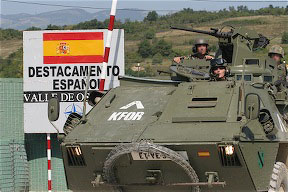
In all, 23,000 Spanish service persons have been in Kosovo during this time, with their principal base —Base "España"— established in Istok. Integrated in Multinational Brigade West, a 470 square kilometre area of action corresponded to them; outstanding within this is the Osojane Valley, where Serbs retuning to their homes in 2001 live, in the first movement of this type following the end of the conflict.
Mission Milestones
The mission in Kosovo has been outstanding due to the proximity and interaction of the Spanish troops with the civilian population. One of the manners of establishing direct contact with the Kosovars has been through medical attention. In fact, the Army Advance Medical Echelon (EMAT) which left in the first relief, on 1st November 1999, carried out over 5,000 medical care actions and in the first year the average number of consultations was 30 daily.
Furthermore, Spanish troops have undertaken during the mission various plans to foster tolerance among ethnic groups, road education or general training of the residents. The most outstanding: the “Clarín” educational programme, which achieved uniting Albania and Serbian children together in class; or the “Cervantes” programme, which began in February 2000 and closed definitively on 18th May of this year, thanks to which Kosovars have been able to learn the Spanish language.
Spain gained influence in the mission, its work was much appreciated and recognition arrived. Lieutenant General Ortuño became the first Spaniard to command the Eurocorps, which deployed in Kosovo in the spring of 2000, for which it transferred its Headquarters there with 350 members, of whom 71 were Spaniards.
KFOR, made up of 45,000 service persons in June 2000, became the force with the greatest number of service personnel ever deployed by NATO.
As well, the Spanish troops detached in Kosovo in May 2002 had the honour of participating in the main ceremony on Armed Forces Day, presided over by King Juan Carlos, which was celebrated for the first time outside of Spain. His Royal Highness the Prince visited Istok shortly afterwards, in September, and also the president elect of Kosovo, Mr. Fatmir Sejdiu, who expressed gratitude to the Spanish soldiers for their labour.
The sad note to these achievements was given by the nine deaths during the ten-year mission, the last in October 2007, following a traffic accident.
Redeployment
After a decade in the region and the declaration of independence by Kosovo on 17th February 2008, NATO has found itself immersed in a reduction process of KFOR force volume.
In this Contact, the ministress of Defence, Ms. Carme Chacón, announced in April 2009 the redeployment of the Spanish Force, where after the departure of Task Force KSPFOR XXIII, now there only remains a unit in charge of materiel collection—the Redeployment Support Unit in Kosovo (KSPUAR)— with 250 members. They will definitively close down the 10-year mission.
ARMY UNITS
- Araba Álava |
- Albacete |
- Alicante |
- Almería |
- Asturias |
- Ávila |
- Badajoz |
- Barcelona |
- Burgos |
- Cáceres |
- Cádiz |
- Cantabria |
- Castellón |
- Ceuta |
- Ciudad Real |
- Córdoba |
- A Coruña |
- Cuenca |
- Girona |
- Granada |
- Guadalajara |
- Gipuzkoa |
- Huelva |
- Huesca |
- Islas Baleares |
- Jaén |
- León |
- Lleida |
- Lugo |
- Madrid |
- Málaga |
- Melilla |
- Murcia |
- Navarra |
- Ourense |
- Palencia |
- Las Palmas |
- Pontevedra |
- La Rioja |
- Salamanca |
- Segovia |
- Sevilla |
- Soria |
- Tarragona |
- Santa Cruz de Tenerife |
- Teruel |
- Toledo |
- Valencia |
- Valladolid |
- Bizkaia |
- Zamora |
- Zaragoza
OUTSTANDING LINKS
Mapa del sitio