





Ejército de Tierra
- Home
- UNITS
- A Coruña
- Operational Logistic Force
- Find us
- Headquarters Palace
Texto no traducido Fuerza Logística Operativa
ARMY UNITS
- Álava |
- Albacete |
- Alicante |
- Almería |
- Asturias |
- Ávila |
- Badajoz |
- Barcelona |
- Burgos |
- Cáceres |
- Cádiz |
- Cantabria |
- Castellón |
- Ceuta |
- Ciudad Real |
- Córdoba |
- A Coruña |
- Cuenca |
- Girona |
- Granada |
- Guadalajara |
- Guipúzcoa |
- Huelva |
- Huesca |
- Islas Baleares |
- Jaén |
- León |
- Lleida |
- Lugo |
- Madrid |
- Málaga |
- Melilla |
- Murcia |
- Navarra |
- Ourense |
- Palencia |
- Las Palmas |
- Pontevedra |
- La Rioja |
- Salamanca |
- Segovia |
- Sevilla |
- Soria |
- Tarragona |
- Santa Cruz de Tenerife |
- Teruel |
- Toledo |
- Valencia |
- Valladolid |
- Vizcaya |
- Zamora |
- Zaragoza
Find us

THE PALACE OF "CAPITANÍA GENERAL"
The first Palace of "Capitanía General" dates back to the sixteenth century and stands on the same premises as nowadays.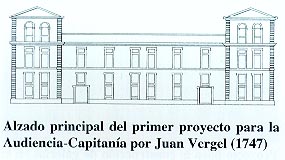
As time passed, the old building’s wooden flooring deteriorated to such an extent that in the eighteenth century it was discarded.
In 1748 under the law by Fernando VI a new building was constructed on the same premises which included a clock, cistern, living quarters for the General of the Army and premises for the courts.
So as to finance the construction, the creation of a tax of one old Spanish coin for every two litres of wine which was harvested in Galicia was agreed upon. Obviously, this measure was to the detriment of the harvesters from Orense, who protested vigorously.
The military engineer Juan Vergel’s initial project proposed a three storey building, rectangular in shape and with an indoor patio. On the 6th November 1748, the first stone of the building was placed.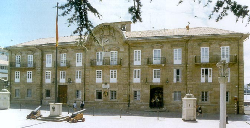
Vergel died in 1750, and was substituted by Francisco Llovet, who directed the construction until its completion, bringing in such drastic changes that it is believed he only heeded to the dimensions of the floor and in the indoor patio.
The construction of the building took four years, two more than foreseen.
The building has two entrances, to clearly separate the premises of the Court from those of the Headquarters.
Subsequent alterations until the twentieth century only affected the interior distribution, the cistern, the rainwater system and the vaulted premises of the building’s basement used for archives. In 1910, the top floor was used for exclusively special occasions and as the living quarters for the Field Marshal. On the left flank of the building, stables were built which were gradually transformed into garages, and the archive site was transformed into dormitories.
 From the very beginning, the Palace of "Capitanía General" had a clock on the main façade which worked from the eighteenth century until well into the twentieth century. Once its original machinery, currently at the Military Museum, started to falter it was replaced in the year 1952.
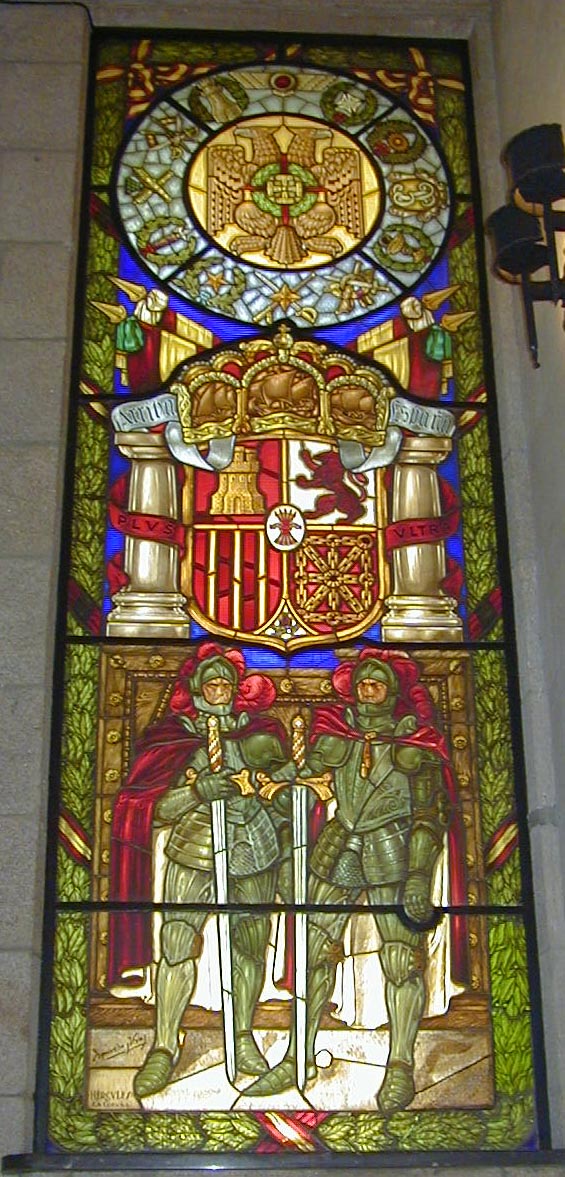
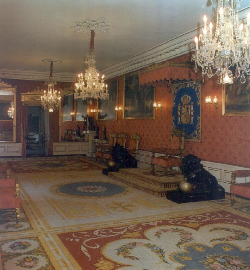
As we make our way to the Palace, we can appreciate first of all, the wonderful stained glass windows near the entrance stairs, before going through to the Throne Chamber with its impressive carpets and paintings. This leads to the Mirrored Corridor, ending with a visit to the indoor patio.
THE ARTISTIC HERITAGE OF THE PALACE
The collection of paintings which decorates the rooms and the corridors of the Palace of "Capitanía General" include works of art belonging to the Prado Museum and are considered National Heritage. The paintings are diverse in nature and span from the seventeenth to the twentieth century.
The assets which belonged to the crown and which from the 1812 Constitution, formed part of the Heritage or the Treasury are regarded as National Heritage.
A large part of these works continue to decorate the palaces and monasteries, in many cases open to the public, while a selection of others can be found in different official buildings which the public do not have access to.
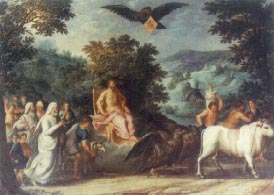 Within the collection of paintings, the most interesting selection that comes from the Prado Museum mainly belong to the Baroque period, a high point being the Flemish, Italian, French and Spanish schools. Another highlight is the selection of large paintings which centre on the months of the year. Within this peculiar calendar, esoteric elements are superimposed, with pagan deity and references to classical culture, to everyday existence and an interest in nature, all characteristic traits of the Baroque period.
The month of January is missing since it is in the Prado Museum.
Another important section of the artistic funds are the Decorative Arts, where objects from ceramic, collections, mirrors, fans, watches, ivories, glass, furniture, metals and books can be seen.
The glass lamps of the Granja style and the mirrors are some of the pieces that complete the decoration of the Palace.


