

MENÚ UNIDAD
UNIDADES DO EXÉRCITO
- Araba Álava |
- Albacete |
- Alicante |
- Almería |
- Asturias |
- Ávila |
- Badajoz |
- Barcelona |
- Burgos |
- Cáceres |
- Cádiz |
- Cantabria |
- Castellón |
- Ceuta |
- Ciudad Real |
- Córdoba |
- A Coruña |
- Cuenca |
- Girona |
- Granada |
- Guadalajara |
- Gipuzkoa |
- Huelva |
- Huesca |
- Islas Baleares |
- Jaén |
- León |
- Lleida |
- Lugo |
- Madrid |
- Málaga |
- Melilla |
- Murcia |
- Navarra |
- Ourense |
- Palencia |
- Las Palmas |
- Pontevedra |
- La Rioja |
- Salamanca |
- Segovia |
- Sevilla |
- Soria |
- Tarragona |
- Santa Cruz de Tenerife |
- Teruel |
- Toledo |
- Valencia |
- Valladolid |
- Bizkaia |
- Zamora |
- Zaragoza

Museos Militares
Colecciones Museísticas
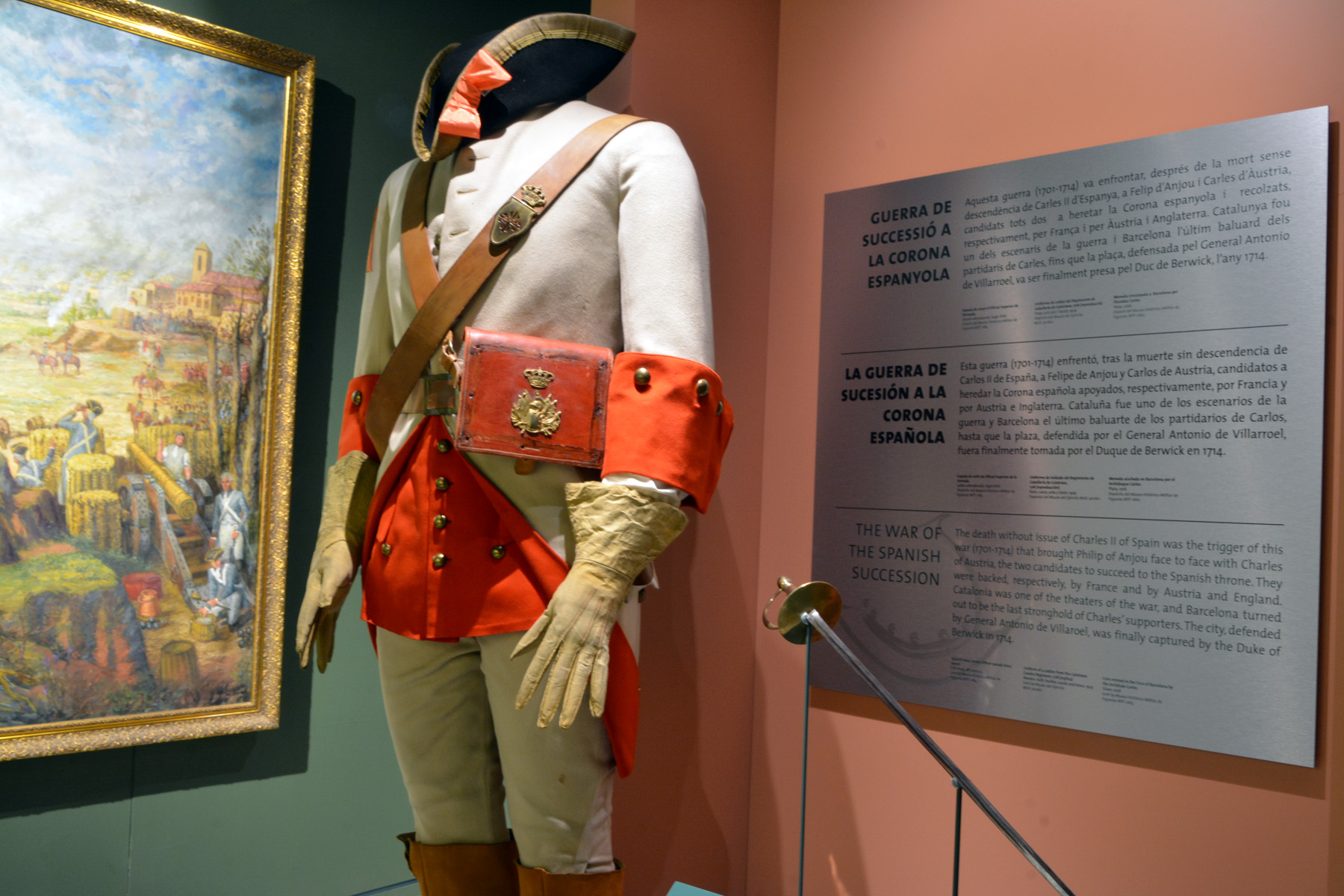

The origin of this war- of dynastic nature and European scope- was the death without issue of Charles II- the last Habsburg king ofSpain-, which entailed the ascent to the throne of Philip, Duke of Anjou and grandson of Louis XIV of France; a testamentary disposition that was forcefully challenged by Holy Roman Emperor Leopold I, who defended the claims of his son Archduke Charles of Austria. Philip was proclaimed king in 1701 under the name of Philip V of Castile and IV of Aragon and was recognized by the Parliament in Barcelona in 1702.
That same year, the"Grand Alliance"- formed by the United Kingdom, the Dutch United Provinces and the Em pire-, in the face of the threat posed by the potential union of the French and Spanish monarchies, declared war on both crowns.
In 1705, the landing of the Prince of Hessen-Darmstad placed in Charles' hands the city of Barcelona and much of the territory belonging to the former Crown of Aragon. Charles convened the Parliament in Barcelona, too, and he was recognized there as Spanish king. His official name was Charles III of Austria.
The victory of the Bourbon troops commanded by the Duke of Berwick in Almansa (1707) allowed Philip V to enact the first Nueva Planta (New Arrangement) decrees for Aragon and Valenda. The forces loyal to Charles of Austria, who had even entered Madrid on two occasions, were beaten anew at the battles of Brihuega and Villaviciosa (1710) and, eventually, cornered in Catalonia.
But there was then an unexpected tur of events: the Emperor died and Archduke Charles became the heir to the imperial throne. This altered the interests of both camps and favored peace negotiations. Charles set sail for Vienna in 1711 and the allied armies withdrew from Catalonia. Finally, the Treaty of Utrecht was signed in 1713. But, in spite of the new situation, the Deputation of the General (precedent of the Generalitat of Catalonia) resolved to resist on alone. General Antonio de Villarroel was entrusted with the defense of besieged Barcelona. In the end, the city was captured by the Duke of Berwick.
Mapa del sitio