
- Inici
- UNITATS
- Valencia
- Texto no traducido
- Noticias de la unidad
- Texto no traducido
- Two years after its deployment to Malacky Air Base (Slovakia), the NRDC-ESP Corps Forward Element (CFE) has established itself as a key component of NATO’s presence on the eastern flank.
MENÚ UNIDAD
UNITATS DE L'EXÈRCIT
- Araba Álava |
- Albacete |
- Alicante |
- Almería |
- Asturias |
- Ávila |
- Badajoz |
- Barcelona |
- Burgos |
- Cáceres |
- Cádiz |
- Cantabria |
- Castellón |
- Ceuta |
- Ciudad Real |
- Córdoba |
- A Coruña |
- Cuenca |
- Girona |
- Granada |
- Guadalajara |
- Gipuzkoa |
- Huelva |
- Huesca |
- Islas Baleares |
- Jaén |
- León |
- Lleida |
- Lugo |
- Madrid |
- Málaga |
- Melilla |
- Murcia |
- Navarra |
- Ourense |
- Palencia |
- Las Palmas |
- Pontevedra |
- La Rioja |
- Salamanca |
- Segovia |
- Sevilla |
- Soria |
- Tarragona |
- Santa Cruz de Tenerife |
- Teruel |
- Toledo |
- Valencia |
- Valladolid |
- Bizkaia |
- Zamora |
- Zaragoza
Notícies
jueves 26 de marzo de 2026
Nombre: 05
In Kuchyňa, Eslovakia
Two years after its deployment to Malacky Air Base (Slovakia), the NRDC-ESP Corps Forward Element (CFE) has established itself as a key component of NATO’s presence on the eastern flank.
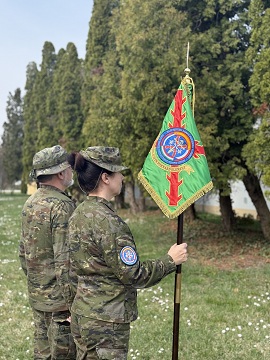
Malacky Air Base
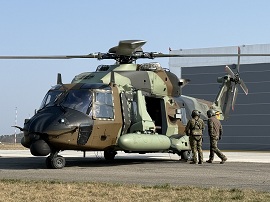
ESP Helicopter Unit
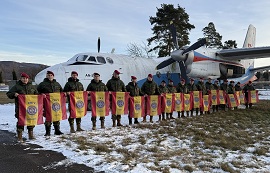
CFE personnel
On 12 March 2024, the Corps Forward Element (CFE) of NRDC-ESP deployed its first rotation to Malacky Air Base in Kuchyňa (Slovakia), thereby demonstrating Spain’s commitment as a reliable and dedicated ally on NATO’s eastern flank. Although Spain contributes with both permanent and temporary forces from the Baltic Sea in the north to the Black Sea in the south, it is here that it has committed to leading an Army Corps through the NRDC-ESP, headquartered in Bétera, Valencia.
This physical distance from Valencia was a key factor in the creation of the CFE, which, from day one, took on a very specific mission: to be on the ground, to understand the situation, to bring stakeholders together, and to pave the way for the NRDC-ESP to assume its responsibilities as a Warfighting Corps when the time comes.
Two years on, this anniversary invites us to look back with hindsight and also with pride. Slowly but surely, our constant efforts to adapt and build relationships have now yielded very tangible results: greater security, greater trust and a strong allied presence on the eastern flank. That decision by the Council of Ministers in December 2023 was not merely a formality; it was a clear commitment to being where we ought to be, alongside our allies, defending together what we share.
But if there is one thing that has truly defined these past two years, it is the human factor. The CFE has gradually built up a network of relationships with its partners in Slovakia and Hungary, which is now one of its greatest assets. Meetings, visits, site inspections, formal and informal gatherings – it all adds up. From the various Joint Operational Commands (JOCOMs) to the Headquarters of the Multinational Division Centre (HQ MND-C) in Hungary, via local authorities, embassies and military commands, every interaction, meeting and activity has served to build trust, understanding and mutual appreciation.
The contingent has received high-level visits, such as that of SACEUR in January 2026. These are clear signs that the CFE’s work is not going unnoticed and that its presence is having a real impact, both militarily and institutionally.
Beyond uniforms and drills, the CFE has also looked beyond its own ranks. Because being deployed is not just about carrying out operations; it is also about integrating into the local community. Activities with civil society, such as the event with schoolchildren in May 2025, reflect this desire to engage, to explain and to share. These are small gestures that have a big impact: they help the local population understand who is there, why they are there and what they are there for.
Two years on, the picture is clear: greater preparedness, a credible deterrent, and interoperability that is no longer just a concept, but a daily reality.

Información
Mapa del sitio